Rip Rap Calculator: Tons for a Bank Measured Down the Face
Enter your project dimensions
Most people reach this page after a storm. A Southern Tier creek came up in an afternoon and took a bite out of the bank behind the house; a culvert outlet cut a hole where the water lands; a stretch of Lake Ontario shoreline lost another two feet of bluff over a winter of waves and ice. The work that follows is heavy and expensive to redo, and the tonnage is far larger than the same area of landscape stone, so the rip rap calculator is worth running carefully rather than quickly.
Getting stone on the bank between high water and ice
Timing is set by the water, not the calendar. Streams here run highest during the spring melt and after summer storms, and shoreline work on the lakes is at the mercy of ice. The workable stretch is usually after the spring rise has dropped and before winter sets in, when the toe can be cut in at low water and equipment can stand on ground that is not frozen or saturated. Shape the bank first, to 2:1 or flatter. A face steeper than that needs an engineer rather than more rock.
Measuring down the face, not across the map
This is where the estimates go wrong. The area you armor is the sloping face, and looking down on it from the top of the bank you see only its horizontal shadow, which is always shorter.
Work it out from the height and the slope. A 6 ft high bank cut to 2:1 rises 6 and runs 12, so the face is the long side of that triangle: the square root of 36 plus 144, which is 13.4 ft. Multiply that by the length of the bank, not by the run. Sixty feet of creek bank at a 13.4 ft face is 804 square feet, where the same bank measured flat from above would have read 720 and left you seven tons light.
For the layer thickness, use 1.5 to 2 times the largest stone you are placing, and never less than 12 inches. Typical 4 to 12 inch residential material gets 12 to 18 inches. Bigger stone or faster water takes 24.
Where the 24 inch depth box stops
The tool takes rectangle, circle by diameter, or multiple areas totaling up to five pieces, which is how a bank and the apron below a pipe get added together. Lengths and widths go in feet, depth in inches from 0.25 to 24. Pick the material, and the 5% compaction and spillage box is ticked unless you untick it. Cubic yards, tons and cubic feet come back together, with an option to have the estimate emailed.
The depth field stops at 24 inches, which is the one limit that bites on this page. A design calling for a 30 inch layer has to be run as two passes, say 15 inches entered twice, with the tonnages added. Do not halve the area instead; that is a different number.
Why 3,100 lb a yard changes everything
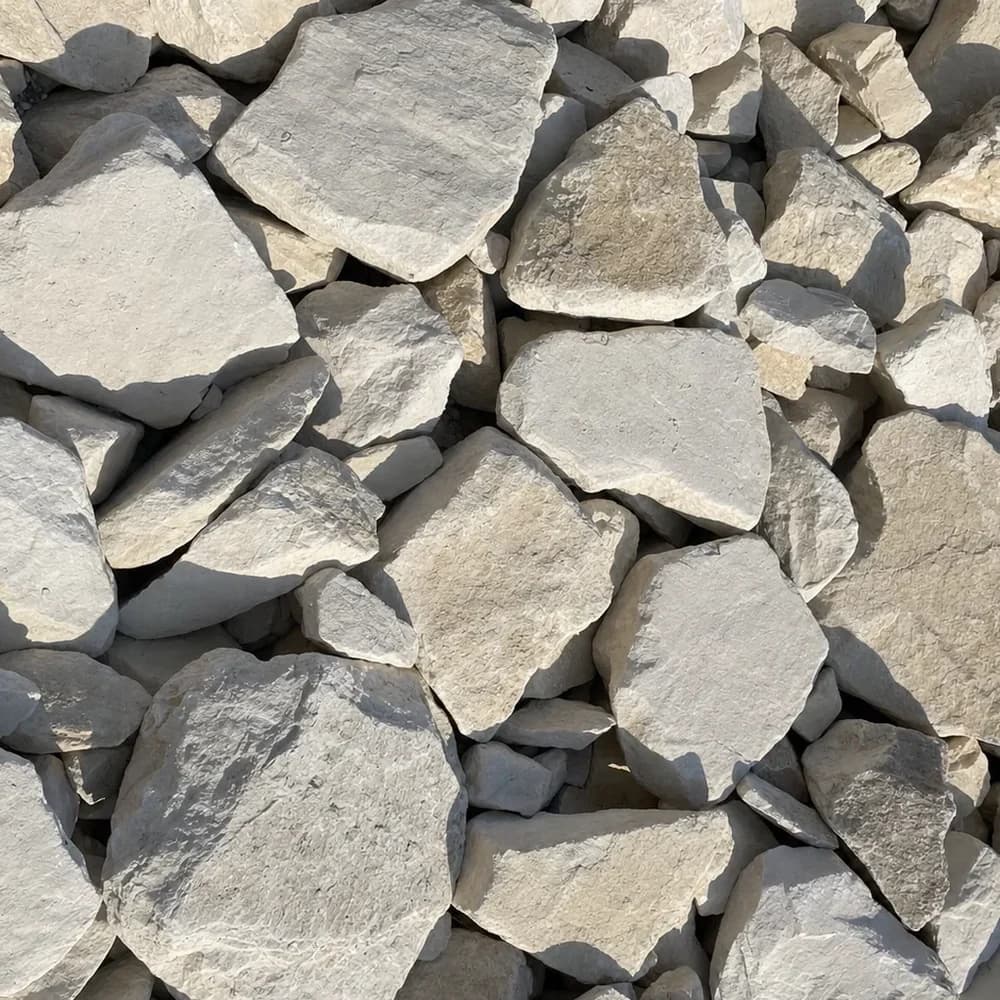
Armor stone is published on this site at about 3,100 lb per cubic yard, or 1.55 tons, the heaviest figure in the catalogue. That is why coverage looks so poor next to landscape material: a ton reaches about 17 square feet at 12 inches, 12 square feet at 18 and 9 at 24, which works out at 5.7, 8.6 and 11.5 tons for every 100 square feet.
The same cubic yard of a different material weighs something else, and that is the whole reason the material select matters. Item 4 and crusher run run 1.50 tons per yard, the clean #2 and #57 grades 1.40, #4 crushed stone and Railroad Ballast 1.45. Pick the wrong row and the volume will still be right while the tonnage is out by several tons on a job this size. Stone is sold here by the ton, so the tons figure is the one that goes on the order.
A creek bank, a culvert apron and the stone underneath
Two hypothetical jobs, with the arithmetic shown.
Sixty feet of creek bank, 6 ft high at 2:1, armored 18 inches deep:
- face 13.4 ft, so 60 x 13.4 = 804 sq ft
- 804 x 18 / 12 = 1,206 cu ft
- 1,206 / 27 = 44.67 cu yd
- 44.67 x 1.55 = 69.2 tons
A culvert apron below a 24 inch pipe, carried 10 ft past the outlet and 8 ft wide, at 18 inches:
- 10 x 8 = 80 sq ft
- 80 x 18 / 12 = 120 cu ft
- 120 / 27 = 4.44 cu yd
- 4.44 x 1.55 = 6.9 tons
Something has to go under the stone, or the soil washes out from beneath it and the whole face slumps, which on a saturated bank through a freeze-thaw winter is a matter of when rather than whether. Either non-woven geotextile, which a landscape supplier carries and this site does not, or 3 to 4 inches of #4 crushed stone as bedding. For the 804 square foot bank, 4 inches of bedding is 268 cubic feet, 9.93 cubic yards and about 14.4 tons at 1.45. Set the bottom course below the waterline or the expected scour depth, because failures start at the toe, and place the top course so the stones bear against each other rather than where they happen to land.
Ask your state and local authorities what approval the work needs before that bottom course goes in below the ordinary high water line of a creek, pond or lake shoreline. Placing rock in and along a watercourse is commonly permitted work, and what is required follows the waterbody.
New York yards and NYSDOT grade this material as light, medium or heavy stone fill, so those are the words you may hear locally for what the catalogue lists as RipRap.
Two jobs that sound similar and are not. A dry creek bed built for looks rather than to carry load is rounded Large River Rock at a landscape depth, and a ditch line taking slower water wants smaller graded stone, sized on the gravel calculator.
Ordering long, because armor stone does not pack
The 5% tick box was built for material that compacts. Armor stone does not. Big angular pieces bridge and leave voids, the toe trench takes more than the drawing says, and a bank is never the flat plane the arithmetic assumes. On a job this size, round up to the next whole ton and keep a small reserve on site for the first walk-over after a heavy rain, when displaced stone goes back and any bare patch between rocks gets filled.
Check truck access before ordering, too. The last twenty feet down to a pond or a creek is where a loaded truck stops being a good idea, and stone dropped in the wrong place gets handled twice. Take the tonnage to RipRap and put the bedding stone on the same order. Delivery is arranged at checkout by ZIP code, and the driver needs a firm route in and a clear place to tip.
Common questions
How do I check the tonnage by hand before I commit to it?
Multiply the slope-face area in square feet by the layer thickness in inches, divide by 12 for cubic feet, divide by 27 for cubic yards, then multiply by 1.55. As a sense check, 100 square feet at 12 inches comes out at 100 cubic feet, 3.7 cubic yards and 5.7 tons, which matches the published coverage figure.
Why does the same 18 inch layer give a different tonnage than it did on the stone calculator?
Because tons follow weight, not space. The cubic yard figure will be identical; the conversion is not. Armor stone converts at 1.55 tons per yard against 1.40 for clean crushed stone, so an 18 inch layer over 800 square feet differs by about seven tons between the two.
Is ticking the 5% box enough of a margin for bank work?
Not on its own. It covers spillage on material that beds down, and armor stone leaves voids instead. Treat it as a floor, then round up to the next whole ton and allow separately for the toe trench, which is dug deeper than the face.
The bank is steeper at one end than the other. How should I measure it?
Split it. Work out the face length separately for each stretch, using the height and slope at that point, then enter each stretch as its own area. Averaging a 4 ft bank and an 8 ft bank into a 6 ft one will get you close, but splitting it is a five-minute job and the tonnage here is worth five minutes.
The work turns a corner at the outlet. Can I total it in one go?
Use multiple areas. Put the bank in as one area and the apron below the pipe as another, up to five in a single calculation, each with its own dimensions and the same layer thickness. Where they overlap at the corner, count that piece once.
Related calculators
Banks don't armor themselves.
RipRap by the ton with free delivery, plus the #4 bedding stone to go under it.