River Rock Calculator for Curved Beds and Creek Lines
Enter your project dimensions
The order that lands short is nearly always the one measured as a single rectangle. Dry creek lines wander, a foundation border bends around a bulkhead, and a bed cut into a Hudson Valley slope runs wider at the bottom than at the top. The river rock calculator will convert any area you hand it, which means the accuracy is settled outside with a tape, not on the screen.
Breaking a wandering creek line into straight pieces
Mark the shape with paint or a garden hose before you measure anything, then treat it as two or three straight pieces rather than one curve.
For a channel, pace the center line for length and take the width in three or four places, then average them. A bend reads wider than it is if you measure around the outside of the curve. For a bed with one straight edge against the house and one loose edge in the lawn, measure the straight side and the widest point, and accept that squaring off a curve leaves a little spare. That surplus gets used anyway, because the front edge of a bed thins first.
Take the numbers in feet rather than paces. On stony upstate ground few lots are flat enough for a reliable stride, and a foot of error over a 40 foot border is most of a ton.
Five pieces totaled in one pass, and where the diameter box earns its keep
Rectangle handles a border or a straight run of bed. Circle takes a single diameter across the widest point, which suits a splash apron under a downspout or a ring around a specimen tree. Multiple areas totals up to five separate pieces at once, so a creek line split into three straights and two pools goes in as one calculation.
Lengths, widths and diameters are entered in feet. Depth goes in inches, anywhere between 0.25 and 24. The material you pick matters, because the tonnage follows the weight of that material. The tick box adds 5 percent for compaction and spillage, which on loose decorative stone is really spillage plus a little settlement into the fabric. Results come back as cubic yards, tons and cubic feet together, and a button sends the estimate to your inbox.
Twice the stone across, or the fabric grins through
Depth on a rock bed is set by the size of the pieces, not the size of the bed. The working rule is roughly double the stone width, and thin layers are why fabric shows through a bed two months after it was laid.
| Stone size | Depth to enter | Where it suits |
|---|---|---|
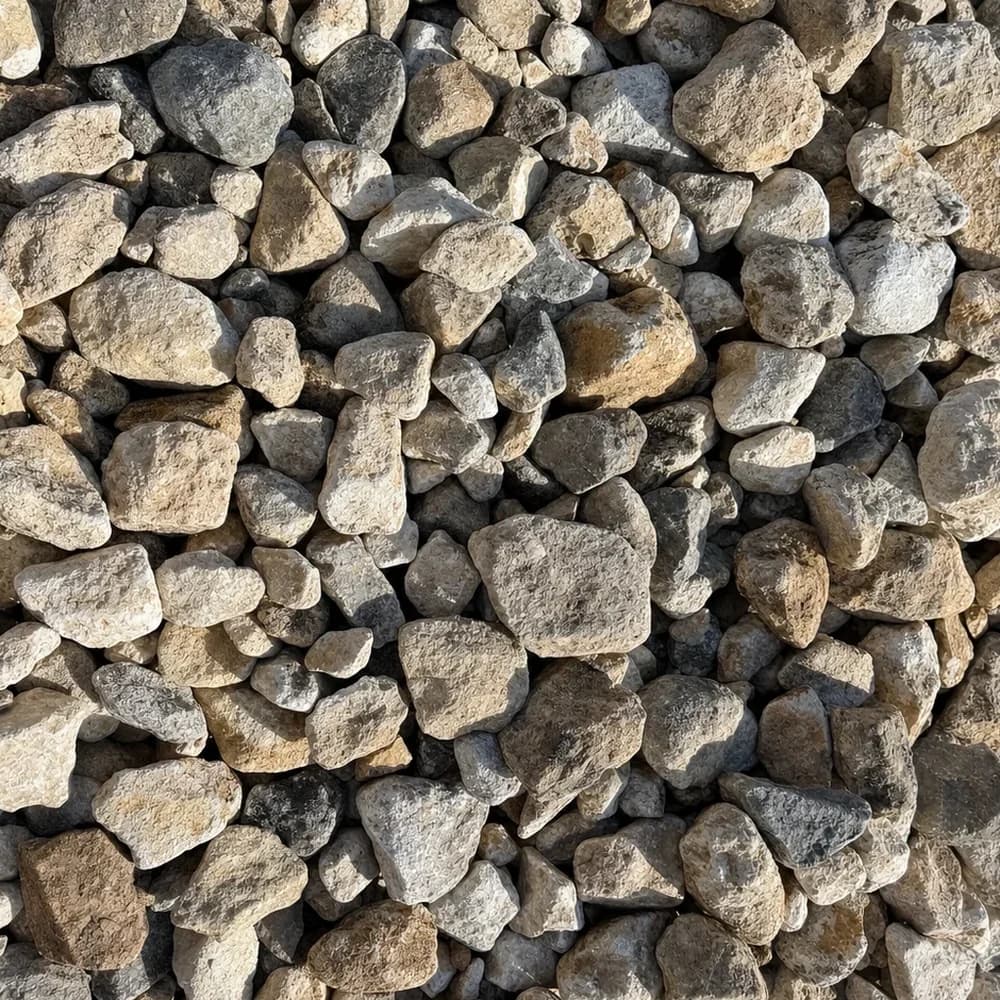
| 3/4 to 1 in rounded stone | 2 in | Narrow borders and paths |
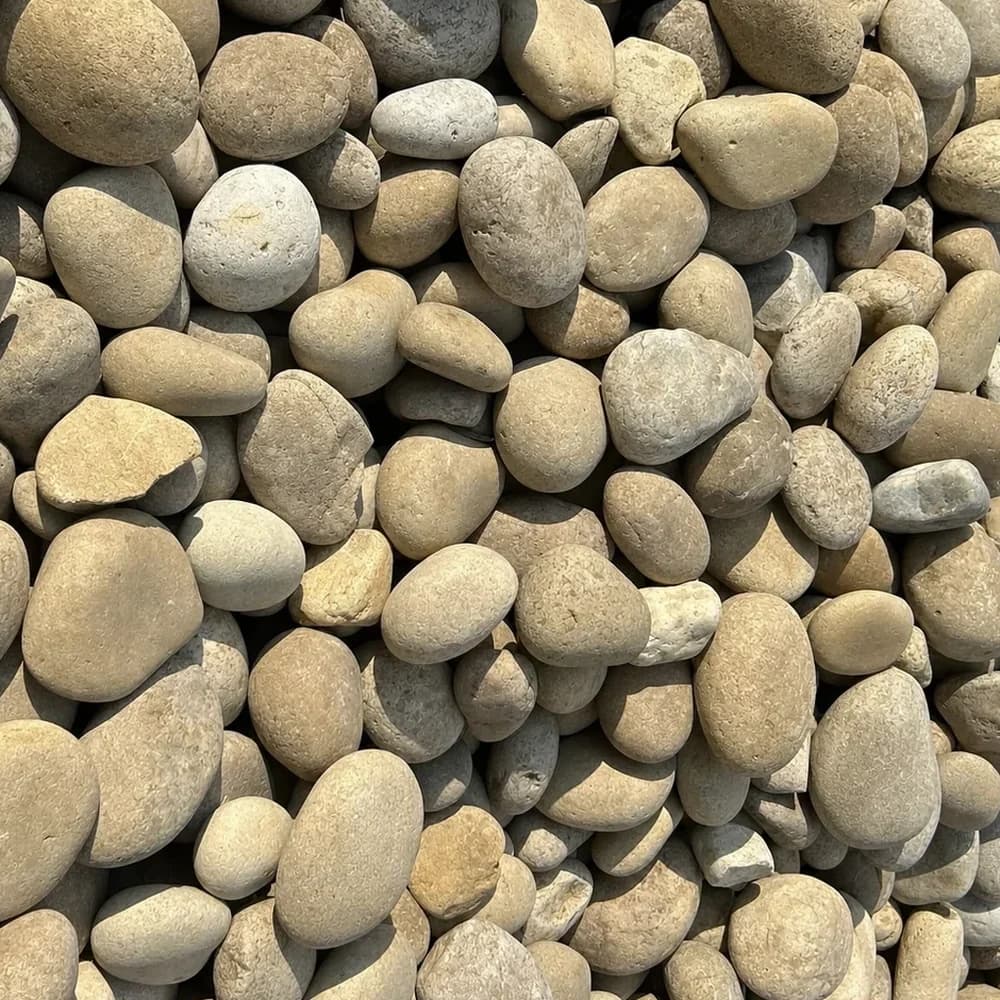
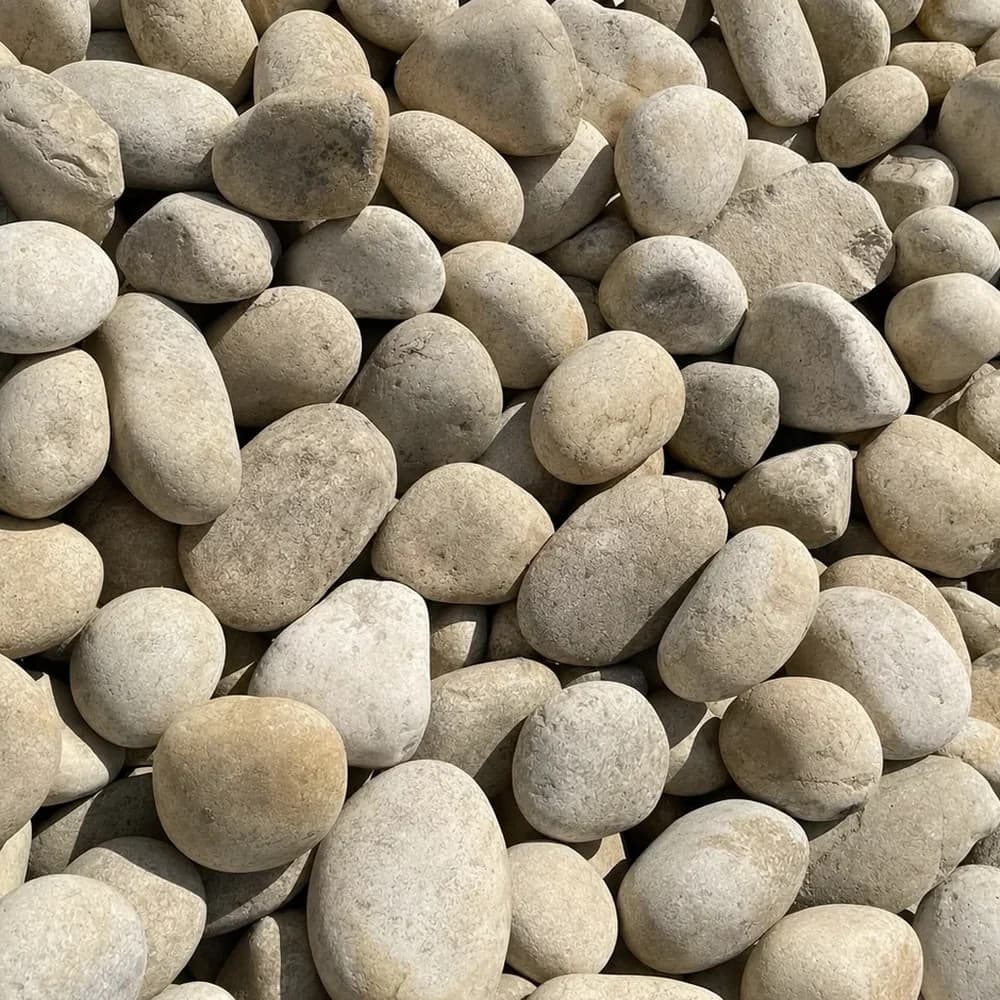
| 1 to 3 in river rock | 3 to 4 in | Beds, splash aprons, creek lines |
| Large river rock, 2 to 4 in | 4 to 5 in | Channel bottoms and heavy edges |
| Oversize accent pieces | placed singly | Set by hand, not spread |
The same ton of larger stone covers about half the ground the small stone does. At 2 inches a ton spreads over roughly 120 square feet; at 3 inches, about 80; at the 4 to 5 inches large river rock wants, closer to 53.
Non woven fabric goes down first and gets pinned, or the stone works its way into the soil and the bed needs topping up in a few years. Where the rock is carrying water rather than just looking good, wrap the stone in the fabric instead of laying it underneath.
Two thousand seven hundred pounds a yard, and a ton that looks small
This site publishes river rock at about 2,700 lb per cubic yard, which is 1.35 tons a yard. Run that backwards and a delivered ton is only about three quarters of a yard, so the pile on the driveway usually looks smaller than the number led you to expect. Nothing has gone wrong. Rounded stone is lighter per yard than the crushed grades on the stone calculator, which mostly start at 2,800 lb.
To check a result by hand: multiply length by width for square feet, multiply that by the depth in inches divided by 12, divide by 27 for cubic yards, then multiply by 1.35.
A splash apron under four downspouts and a border on Long Island sand
All three of these are made up examples, with the arithmetic shown.
Four downspout aprons, 5 ft across, 4 inches deep. A 5 ft circle is 19.63 square feet. At 4 inches that is 19.63 x 4 / 12 = 6.54 cubic feet, or 0.24 cubic yards, and 0.24 x 1.35 = 0.33 tons. Four of them come to about 0.97 cubic yards and 1.31 tons. Enter them as four areas in one pass rather than multiplying in your head.
A 38 by 3 ft foundation border, 3 inches deep. That is 114 square feet. 114 x 3 / 12 = 28.5 cubic feet, 28.5 / 27 = 1.06 cubic yards, and 1.06 x 1.35 = 1.43 tons. Sandy outwash ground on Long Island takes roof runoff away quickly, so a border here is mostly about keeping splash off the siding and giving the mower a clean edge. Grade it gently away from the wall.
A three part creek line: 20 by 4, 12 by 4 and 9 by 3 ft, at 4 inches. The pieces total 155 square feet. 155 x 4 / 12 = 51.67 cubic feet, 51.67 / 27 = 1.91 cubic yards, and 1.91 x 1.35 = 2.58 tons. With the 5 percent box ticked that becomes 2.01 cubic yards and 2.71 tons. Set the largest stones a third of their height into the ground so the channel looks shaped by water rather than tipped from a bucket.
Hose the load down before you judge the color
Delivered stone often arrives with quarry dust on it, and the color people were expecting appears after a rinse. Do that before deciding the load is wrong.
Then take the tonnage across to the listing that matches what you calculated, set the quantity and choose a delivery date. Delivery is arranged at checkout by ZIP code, and the driver needs a clear route to a firm spot to tip. Tarp the ground first if the pile is landing on a new apron, because rounded stone rolls further than you expect.
Common questions
Can I put a plainer stone underneath and keep the river rock for the layer that shows?
Yes, and in a deep channel it is worth doing. Size the two layers separately: run the tool once for the bottom course at its own depth, then again for the top. The weights differ, so change the material each time. River rock converts at 1.35 tons a cubic yard here, while crushed 3/4 inch crushed stone or drain rock converts at about 1.40. Put both on one delivery.
My bed is a long curve with no straight sides at all. What do I measure?
Length along the center of the curve, and width at three or four points across it, averaged. Enter that as a rectangle. If the shape pinches in the middle, split it at the pinch and enter the two halves as separate areas instead. Squaring off a curve always leaves you slightly more stone than the shape holds, which is the right direction for the error to run.
The bed is already stoned and has just gone thin. How do I size a top up?
Measure how far the stone sits below the edging with a ruler at several points and average those readings, then use that figure as your depth. A 300 square foot bed that has dropped an inch needs 300 x 1 / 12 = 25 cubic feet, which is 0.93 cubic yards, or 1.25 tons. Rake the old stone level first, because most thin beds are uneven rather than short.
What actually goes wrong if I am a quarter ton light?
The layer finishes shallow, and shallow is where rock beds fail. Fabric shows in the gaps, weed seed lands on soil instead of stone, and the bed wants redoing far sooner. Rounding up to the next quarter ton costs less effort than a second trip for a wheelbarrow of stone.
How close is the estimate to what the bed swallows?
The arithmetic is exact. The ground is not. Rounded stone settles into fabric, the low end of a sloped bed always takes more, and hand measured curves are approximations. Treat the result as a floor rather than a ceiling, and leave the 5 percent ticked on anything bigger than a single planting bed.
Related calculators
Rock beds are a one-time buy.
River rock, large river rock and drain rock by the ton, free delivery included.