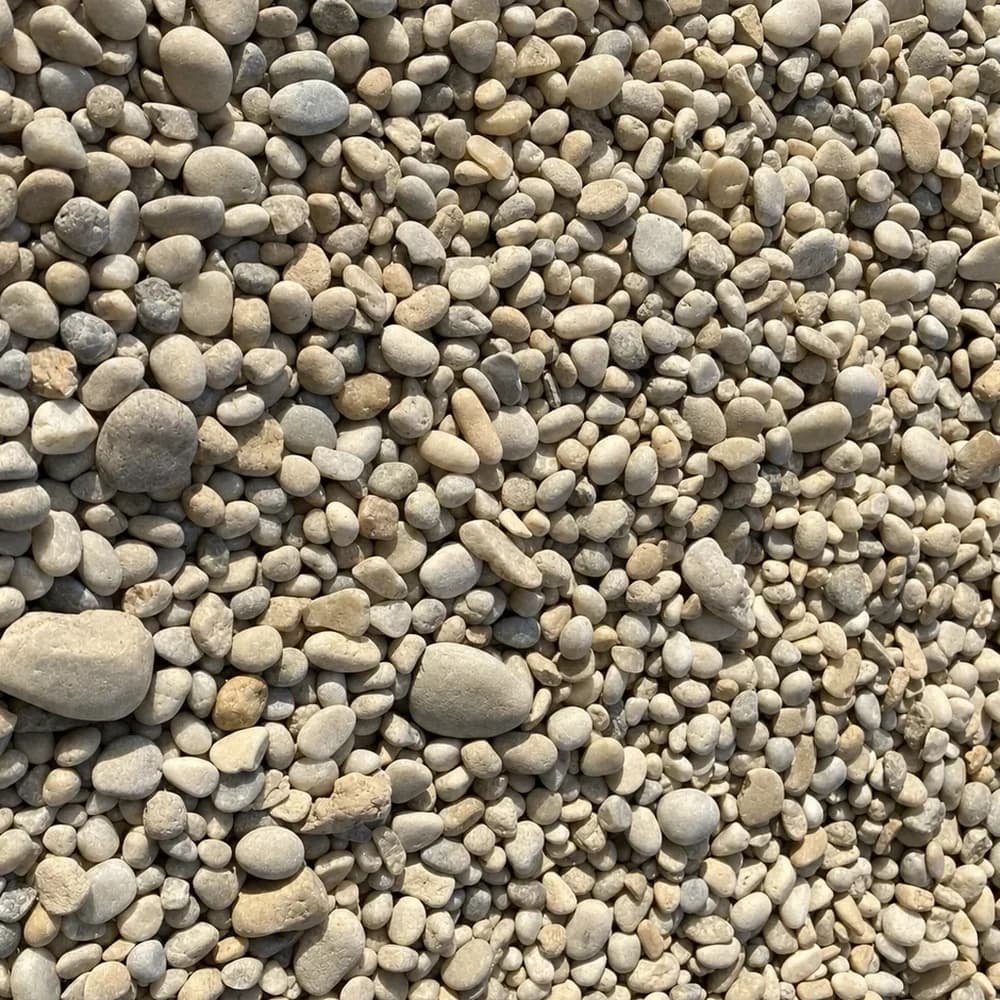
Pea Gravel Calculator: Laying a Fire Pit Circle and a Dog Run
Enter your project dimensions
Loose stone wants to go down after the ground has finished moving. Upstate that means waiting until the frost is properly out and the softened ground has drained and settled, because a bed laid over a heaving subgrade in March ends the spring with a dip in the middle. The other end of the year matters too: a surface laid in late October meets a snow shovel within weeks, and a steel blade scrapes rounded stone off a path faster than any amount of foot traffic. The pea gravel calculator sits in the middle of that job, after the measuring and the edging decision, and this page follows one hypothetical back yard through the whole of it.
Pacing the circle and the run before ordering anything
The yard in the example has two pieces of work: a fire pit sitting area 17 ft across, and a dog run 20 by 10 ft behind the garage.
Round areas are measured straight across, through the middle, which is the diameter the circle mode asks for. A 17 ft circle works out at about 227 square feet. Rectangles are length by width in feet, so the run is 200 square feet. Both can go into the tool in one pass using multiple areas, which totals up to five shapes, though not if the two want different depths. Here they do not, so one calculation covers both.
Measure to the inside face of whatever will hold the stone in, not to the outside of the edging.
Between 2 and 3 inches, with playgrounds the one exception
Depth for pea gravel is narrower than for most materials on this site. Under 2 inches the ground shows through in the traffic line. Over 3 inches it walks like dry sand and your heel sinks. So 2 to 3 inches for anything people stand on, and that is the whole range, with one exception: a playground fall zone wants 9 to 12 inches of loose material, kept topped up, and the equipment manual sets the figure. What the tonnage buys, though, is landscape pea gravel. It is not sold as certified playground surfacing, and the required depth, the fall-zone footprint and the maintained depth all come from the equipment manufacturer's instructions rather than from us.
In the tool, pick the shape, enter feet for lengths and diameters and inches for depth, anywhere from 0.25 to 24. Select the material so the conversion is right, leave the 5% extra for compaction and spillage ticked if you want the margin, and press calculate. Cubic yards, tons and cubic feet come back together, with a button to email the estimate.
Both areas at 3 inches:
- fire pit circle: 227 x 3 / 12 = 56.75 cu ft, 56.75 / 27 = 2.10 cu yd, 2.10 x 1.40 = 2.94 tons
- dog run: 200 x 3 / 12 = 50 cu ft, 50 / 27 = 1.85 cu yd, 1.85 x 1.40 = 2.59 tons
- together, 3.95 cu yd and 5.53 tons, so order 6 tons
For scale, a 20 by 15 ft play area at the full 12 inches is 300 cubic feet, 11.11 cubic yards and 15.6 tons on its own. Fall zones are not a bag job.
Edging, and the 5 percent grade where it stops working
Rounded stone rolls. That is the whole character of the material, and it is why edging goes in first rather than last. Steel, aluminum, timber or a paver soldier course, set about an inch above the finished stone level, keeps it where you put it. Edging flush with the surface loses stone over the lip within a season.
Slope is the limit. Above roughly a 5 percent grade, edging alone will not hold it, because rain and feet move the stone downhill regardless. On a sloped side path, either lay a honeycomb stabilizing grid under the gravel, or change material: #1 stone is the same 3/8 inch size but crushed, and the angular faces lock together on a grade where rounded stone will not. Under a seating area, 2 inches of compacted Stone Dust below the gravel keeps chair legs from sinking.
Rounded, crushed or river stone over the same 154 square feet
The tonnage barely moves between the first two; the surface does. Pea gravel is the comfortable one underfoot and the one that travels. Walkway gravel is crushed, so it beds down and holds a path that gets daily use, and #1 stone does the same job at the smaller size; both are sized on the gravel calculator. River rock is larger, meant to be looked at rather than walked on, and at about 2,700 lb a cubic yard it is the one of the three with a different conversion, so it goes through the river rock calculator. One property using all three is normal: crushed on the sloped side path, rounded around the fire pit, river rock along the foundation line.
Raking the track back after the frost comes out
Spring is when a stone surface gets its maintenance. Freeze and thaw work stone down into the subgrade and the shovel takes some off the edges over winter, so rake the traffic line back flat and top up from a bucket or two held back for exactly that. A path gets a rake twice a year and little else. Around a fire pit, the stone drains rain away overnight and does not burn, which is most of why it is there.
Keep back a few buckets from the delivery rather than ordering again for a wheelbarrow's worth.
The 2,800 lb surprise, and what a yard covers
Pea gravel feels light underfoot and is not. This site publishes it at about 2,800 lb per cubic yard, or 1.40 tons, the same as #57 and the other clean 3/4 inch grades, because rounded stone packs with less air between the pieces than people expect. One yard covers about 108 square feet at 3 inches, or 162 at 2 inches.
It is sold here by the ton, so the tons figure is the one for the quantity box, and the cubic yard figure tells you the pile size. Take the number to 3/8" Natural Pea Gravel, choose a quantity and a delivery date. Delivery is arranged at checkout by ZIP code and the truck needs a firm, clear spot to tip.
Common questions
The path has thinned out in the middle. How much do I order to top it up?
Measure the worn strip rather than the whole path, and use the depth you are actually adding, often half an inch to an inch. A 30 by 3 ft traffic line at 1 inch is 90 square feet, 7.5 cubic feet, 0.28 cubic yards and under half a ton. Rake the old stone level first, because the low patches take more than the average suggests.
What if I come up short on a fire pit circle?
You get a thin ring at the outside where the last wheelbarrow ran out, and it shows. Order to the next half ton and spread from the outside edge inwards so any shortfall lands in the middle, where the fire pit itself covers it.
Is the tonnage reliable at these depths?
The arithmetic is, but 2 inches spread by eye is easily 2.5 in places, and that difference is a quarter of the order. Set a couple of depth stakes or rake to the top of the edging, and keep the 5% ticked.
Which page do I order from, and does the calculator carry the number over?
The natural pea gravel page, by the ton. The result links through to it, and the quantity you set there is what gets delivered.
Where do six tons of loose stone go while I spread it?
On a tarp on something hard, close to the work and never on the lawn, because rounded stone disappears into grass and comes back out with the mower. Leave the driver a straight run in. If the fire pit and the dog run are at opposite ends of the property, it is easier to drop one pile in the middle than to ask for two.
Related calculators
Under two tons covers most patios.
3/8 inch natural pea gravel, priced by the ton, delivered free.