Road Base Calculator: Compacted Depth, Then Tons
Enter your project dimensions
Standing at the end of an apron you can see the easy half of the problem: how wide the pad is, how far the pull-in runs, where the grass stops and the stone has to start. What decides the tonnage is the foot of ground underneath, and on the flat clay plains west of Syracuse or along the St. Lawrence that foot is the difference between a base that finishes proud and one that vanishes into the subgrade. The road base calculator handles the arithmetic honestly. It has no way of knowing what is under the grass.
What the tape reaches, and what stays out of sight
Three things sit outside the numbers you can type in.
The subgrade takes its cut first. Silt and clay left by old glacial lakes stay soft well into spring, and the first stone rolled onto soft ground is pushed down rather than built up. Where that is likely, a woven geotextile under the stone keeps the two layers from mixing and is worth more than an extra inch of aggregate.
Depth is the number people guess, and guessing it low is how a job runs short. What counts is the finished, rolled thickness, not the loose depth you spread, because a graded mix with fines in it tightens considerably under a plate compactor.
And edges are never square. A pad spreads at the sides as it is rolled, and an apron meeting a town road always eats more than the drawing shows. Measure the finished footprint you want, then round the order up rather than trimming it.
Tons on the ticket, yards in the hole
This site publishes road base at about 3,000 lb per cubic yard, which is 1.50 tons a yard. That is the heavy end of the catalogue, and the fines are the reason: the dust in a graded mix packs the gaps between the stones, so a yard of it outweighs a yard of anything washed.
The estimate comes back in both units on purpose. Cubic yards describe the hole, which is what matters when you are working out how deep to strip and where the spoil is going. Tons are what the material is sold in, so that is the figure the listing wants. The conversion in either direction is 1.50, and you can check any result by hand: length times width for square feet, times the depth in inches divided by 12, divided by 27, times 1.50.
Item 4 on the drawing, road base in the dropdown
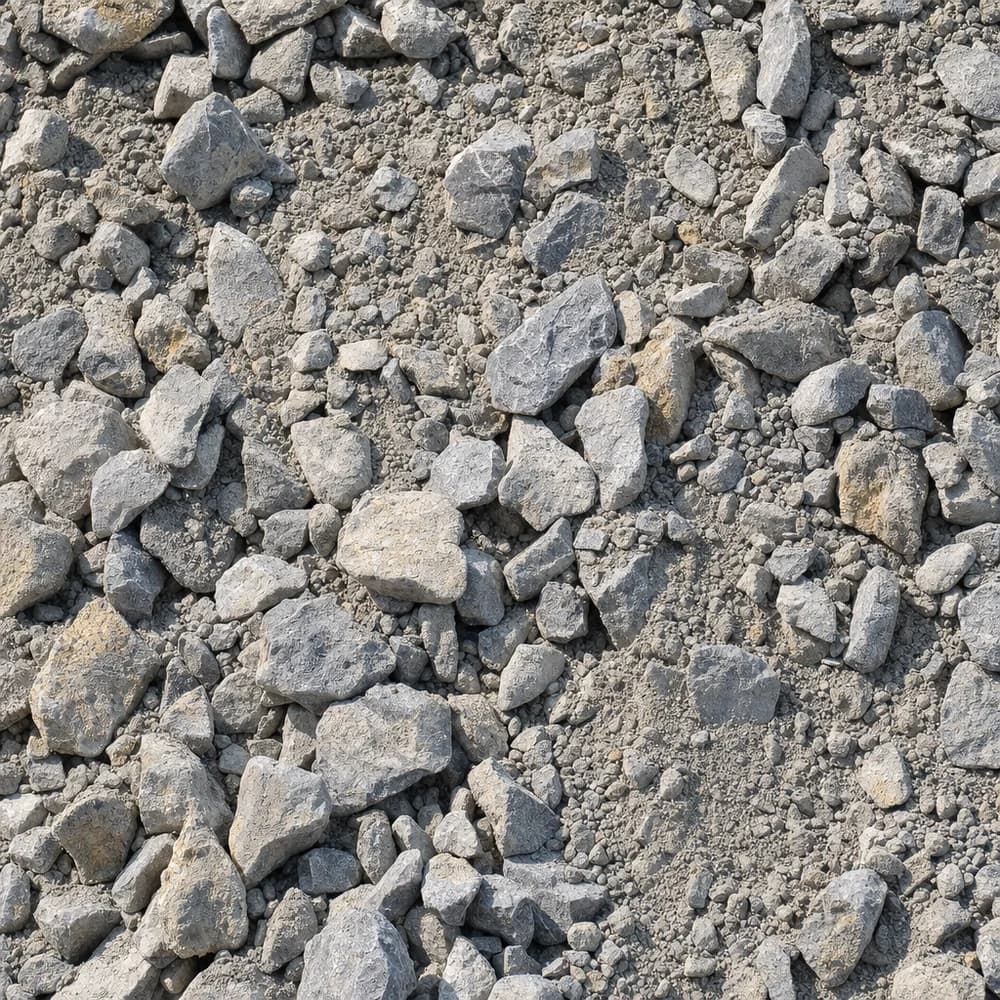
Around here the ticket usually says Item 4. It is the trade name New York yards have always used for compacting subbase stone, and NYSDOT specifies subbase under Section 304, which is how material gets described locally rather than anything this storefront holds a certificate for. Crusher run is a separate listing here. The two weigh the same by the yard; the difference is top size, so a lane or a yard wants the base mix and a paver bed wants crusher run.
Item 4 and road base are the same row in the material list at 1.50 tons a cubic yard, so either word on your paperwork belongs on this page. Crusher run sits on the same weight row and does a different job: it is finer and screeds smoother, which is why flatwork goes to the crusher run calculator and a patio build-up to the paver base calculator. Stay here for a lane, a drive, an apron or a yard.
One thing this material must never go into is a trench meant to drain. The fines that make it lock up also hold water. Clean stone belongs there, sized on the stone calculator.
Putting a shared drive and its pull-offs through the road base calculator
Rectangle covers a pad or a straight run. Circle takes a diameter, useful for a turnaround measured across the middle. Multiple areas adds up to five separate pieces in one calculation, which is how a drive and the passing places along it get totaled together.
Lengths, widths and diameters go in feet, depth in inches from 0.25 to 24. Choose the material so the weight is right, and leave the 10 percent for compaction and spillage ticked on anything you intend to roll. Cubic yards, tons and cubic feet come back together, and the estimate can be emailed to you.
A hypothetical example, entered as three areas: a shared drive 140 by 11 ft, plus two pull-offs of 10 by 12 ft each, all finished at 6 inches compacted.
- 140 x 11 = 1,540 sq ft, plus 2 x 120 = 240 sq ft, so 1,780 sq ft in total
- 1,780 x 6 / 12 = 890 cubic feet
- 890 / 27 = 32.96 cubic yards
- 32.96 x 1.50 = 49.44 tons
- with the 10 percent ticked: 36.26 cubic yards, 54.38 tons
Depths for an apron, a container corner and an equipment yard
| What sits on it | Compacted depth | Note for this ground |
|---|---|---|
| Light residential apron on firm ground | 4 in | Cars and the odd van |
| Everyday drive taking delivery trucks | 6 in | Take the 6 on clay and valley silt |
| Equipment yard, container pad, heavy turning | 8 to 12 in | Also over wet or weak subgrade |
Containers are the awkward case, because the whole weight lands on four corners rather than being spread across the footprint. A full 8 inches plus fabric is the sensible default even on ground that looks solid, or the corners print into the pad after the first thaw.
Second hypothetical: a 10 by 20 ft container pad at 8 inches.
- 10 x 20 = 200 sq ft
- 200 x 8 / 12 = 133.33 cubic feet
- 133.33 / 27 = 4.94 cubic yards
- 4.94 x 1.50 = 7.41 tons
Place it in lifts no deeper than 4 inches and roll each one before the next goes on, misting lightly first. Set a slight crown across a drive so water runs off the sides instead of soaking into the base, and remember the season sets the rest: frozen ground will not compact, so this work runs from the spring thaw into late fall.
Ordering long, and picking the drop spots first
Round up to the next half ton. A base course has to be placed and rolled in one session to finish level, and a layer that is topped up a week later never keys into the material beside it. Leftovers are never wasted here, since they patch the ruts that open when the frost comes out.
Decide where a load of this size will sit before you order it. On a long drive, two drop points beat one heap at the gate, because moving stone by wheelbarrow is the part of the job that takes the days. Keep the pile on firm ground clear of the septic field, and leave the truck a straight run in and out. Delivery is arranged at checkout by ZIP code, and the driver needs clear access to tip.
Take the tonnage to Item 4, set the quantity and pick a date. If the drive also needs a surface course, #57 stone is the usual choice, sized on the gravel calculator and put on the same order.
Common questions
The pad came up eight tons short with half of it spread. Is a second load a problem?
It costs you the finish. Rolled in one session the layer knits together; added a week later it sits as a patch, and the joint between the two shows up in the first wet spring. If it has already happened, scarify the surface of what is down before the new material goes on, and roll the whole pad again rather than just the new part. Better to order to the next half ton and keep the spare.
Is the tonnage reliable over soft ground?
The sum is exact; the subgrade is the variable. Over clay or a wet spot the first inch is effectively lost into the soil, and a pad on ground like that can take noticeably more than the calculation says. Where you expect that, lay geotextile, add depth rather than width, and treat the estimate as a starting figure. If you cannot tell what is under the grass, ask through contact before the order goes in.
My drawing says Item 4 but the dropdown says road base. Which listing do I buy?
The Item 4 listing, which is this site's name for that product. Item 4 and road base are one listing under two names, so the tonnage on screen is the tonnage to order. Crusher run is a separate listing at the same weight, and it belongs under pavers rather than under a drive. If a spec calls out a particular gradation, match that to the product description before you set the quantity.
Should fifty tons land in one pile?
It is easier if it does not. Mark two spots along the drive before delivery day, both on firm ground with a straight approach, so the stone starts closer to where it is going. A single pile at the entrance means wheelbarrowing the far end of the job the whole length of the drive, which is where a weekend disappears.
Why does the estimate show cubic yards when the material sells by the ton?
Because the two answer different questions. Yards tell you the size of the void you are filling, which is what you need when you are stripping sod and working out where the spoil goes. Tons are the sales unit and the figure that goes in the quantity box. At 1.50 tons a yard, one yard of this material spreads about 81 square feet at 4 inches.
Related calculators
Thirty tons. Zero delivery fees.
Road base priced per ton, hauled free, at lane quantities where hauling usually costs the most.