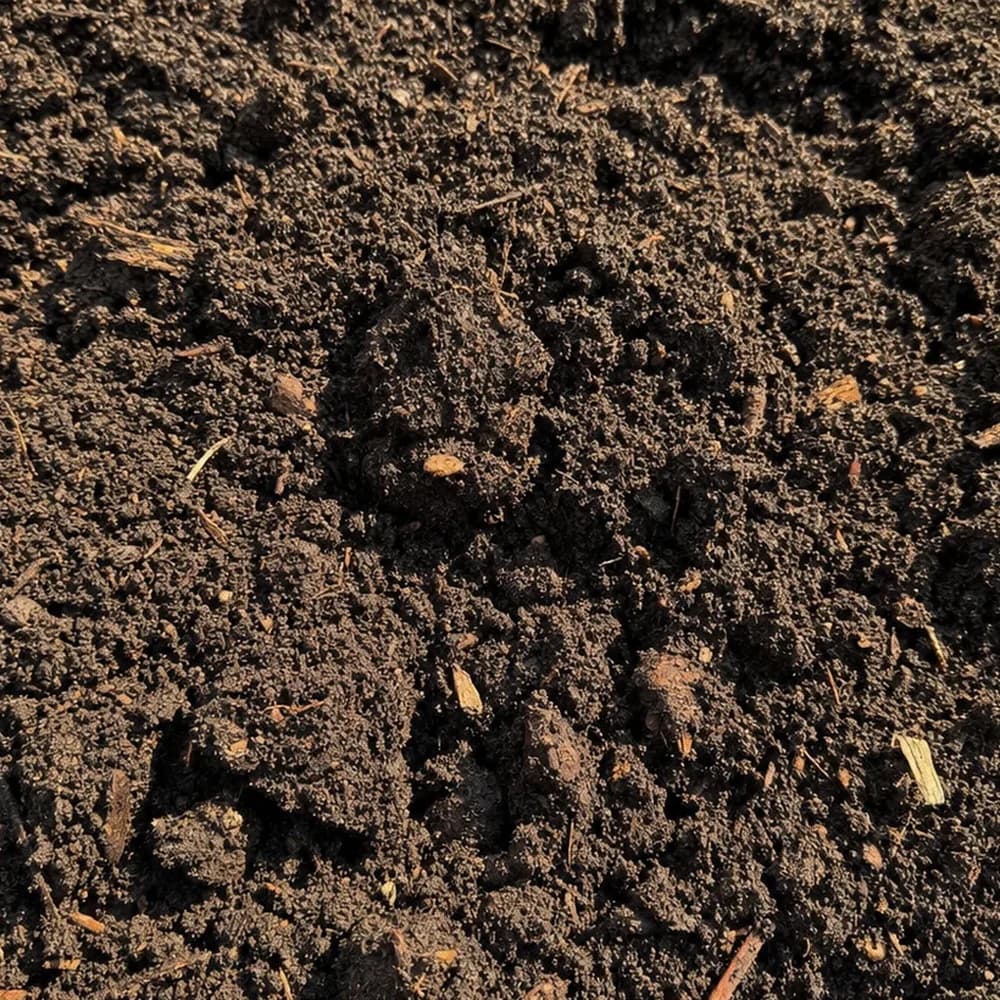
Soil Calculator: Filling Beds Without Ordering Twice
Enter your project dimensions
Raised beds get built on stony glacial till upstate and on sandy outwash across Long Island for opposite reasons, and in both cases what goes into the box is not the material that belongs on the lawn twenty feet away. That distinction is where most soil orders go wrong. This soil calculator sizes the blended growing mix that fills beds, planters and new borders. Lawn work and grade changes are sized elsewhere, and the weights are different for each.
Where a bed order comes out short, and where it comes out long
Beds get measured around the outside of the frame. A 4 by 8 bed built from two-inch boards holds a good deal less than 32 square feet, and on three or four beds that error adds up to a wheelbarrow load.
Depth gets read to the top of the boards, which is fair enough, but a compost-rich blend settles 10 to 20 percent in the first weeks as the organic fraction breaks down. Fill to the rim and you are looking at a dip by the second watering.
Orders come out long when the job is planned in bags and then converted late. About 36 bags at 40 lb make a cubic yard, each holding roughly three quarters of a cubic foot, so a single deep bed is already a stack of bags nobody wants to carry twice.
And deep beds get overfilled with blend. Anything taller than about 18 inches does not need a growing mix all the way down; the bottom third can be plainer material, which is worth two runs of the tool rather than one.
Adding three planters and a bed in one calculation
Rectangle covers a bed or a box. Circle takes a diameter, which handles a round planter or a ring cut around a tree. Multiple areas totals up to five separate pieces at once, so a row of beds goes in as a single job rather than four sums on the back of an envelope.
Enter dimensions in feet, including the fractions: a bed 3 ft 6 in wide is 3.5. Depth goes in inches, from 0.25 to 24. Pick the material, because the tonnage that comes back follows its weight, and use the 5 percent tick box to cover spillage and the soil that vanishes into the ground under an in-ground bed. The result shows cubic yards, tons and cubic feet together, with the option to have it emailed.
A yard that weighs about a ton, and why soil still sells by volume
Blended garden soil is published here at about 2,000 lb per cubic yard, which works out at 1.00 ton a yard and makes the mental arithmetic unusually easy. Screened topsoil is heavier at about 2,200 lb, or 1.10 tons, and fill dirt heavier again at about 2,400 lb, or 1.20 tons.
Soil is bought by the cubic yard, so the yardage is the figure that matters at checkout. Tons are shown because the load is weighed, and because a mixed order of soil and stone is easier to picture in one unit. The conversion is the only part worth remembering: area in square feet, times depth in inches, divided by 12, divided by 27.
Bed jobs here, lawn jobs one page over
| Material | What it is for | Weight a yard | Size it on |
|---|---|---|---|
| Garden Soil | Beds, planters, new borders | about 2,000 lb | this page |
| Screened topsoil | Lawns, seeding, finish grading | about 2,200 lb | the topsoil calculator |
| Fill Dirt | Raising grade, filling hollows, backfill | about 2,400 lb | the dirt calculator |
The order runs from lightest and richest to heaviest and most structural, and the weights follow the same line. Garden soil carries compost, which is why it is the lightest of the three and why it settles most. Fill dirt is subsoil: it holds a grade and grows almost nothing, so it goes underneath and stops 4 to 6 inches below the finished surface.
On the dense upland subsoils of the Southern Tier and the Finger Lakes hills, where water sits near the surface after rain, there is a case for improving what you have rather than importing a whole bed. Working 2 to 3 inches of blend into the top 6 inches of an existing bed uses about a third of the material of a full replacement.
Two 3 by 10 beds, one deep planter and a border refresh
Three hypothetical jobs, with the arithmetic shown.
Two beds, each 3 by 10 ft inside the boards, filled to 11 inches in a 12 inch frame. Together that is 60 square feet. 60 x 11 / 12 = 55 cubic feet. 55 / 27 = 2.04 cubic yards, and at 1.00 ton a yard, about 2.04 tons of garden soil.
One deep planter, 4 by 12 ft and 20 inches tall, filled in two layers. The bottom 9 inches takes fill dirt: 48 x 9 / 12 = 36 cubic feet, 36 / 27 = 1.33 cubic yards, which at 1.20 is 1.60 tons. The top 11 inches takes the blend: 48 x 11 / 12 = 44 cubic feet, 44 / 27 = 1.63 cubic yards, or 1.63 tons. Run the tool twice, once per layer, and change the material each time.
A tired border, 300 sq ft, improved rather than replaced. Working 3 inches of blend through the top of it needs 300 x 3 / 12 = 75 cubic feet, which is 2.78 cubic yards. Till it in rather than leaving it as a lid, so roots cross the join instead of stopping at it.
Ordering a little long, and topping up in week two
Round up to the next quarter yard. Compost-rich material settles, and the top up is the job everybody forgets to plan for: fill the beds slightly proud, water them deeply, then come back once the level has dropped and use the surplus. Beds that are planted heavily usually want an inch or two more each spring after that.
Pick the tipping spot before the delivery. Soil marks a driveway and kills the grass it sits on within days, so a tarp is worth putting down, and the pile should be as close to the beds as the truck can reach with a clear route in and out. Delivery is arranged at checkout by ZIP code, and the delivery page covers the access the driver needs. Set the yardage against Garden Soil, choose a date, and add any capping or fill material to the same order so it arrives together. The mulch calculator sizes the layer that goes on afterwards, and contact is the quickest route if layering a deep bed is the part you are unsure about.
Common questions
The bed is a circle around a maple. How do I work that one out?
Use circle mode and measure the diameter across the widest point, not the radius. A 10 ft circle is 78.54 square feet, so at 8 inches deep that is 78.54 x 8 / 12 = 52.36 cubic feet, or 1.94 cubic yards. Keep the soil off the trunk itself; a mound piled against bark does the tree no favors.
Should I measure to the top of the boards or leave room for settling?
Measure to the top, then expect to come back. Depth here is the loose depth you pour, and a blend with compost in it loses 10 to 20 percent of that as it settles. If you would rather not top up later, round the order up rather than changing the depth you enter, which keeps the figure easy to check.
Can I sanity check the yardage before I commit to it?
Take the classic 4 by 8 bed at 12 inches: 32 square feet, 32 cubic feet of soil, and 32 divided by 27 is 1.19 cubic yards. If your own figure for a bed that size lands near 1.2 yards, your depth units are right. Most disagreements come from entering depth in feet instead of inches.
The beds are in the back yard and the truck can only reach the driveway. Where does the load go?
On the driveway, on a tarp, positioned so you can wheelbarrow straight to the gate rather than round the house. Measure the gate first, because a full wheelbarrow is wider than people assume. A yard of soil is a manageable pile for one person over an afternoon; three yards is a weekend, so plan the route before the order rather than after.
Soil sells by the yard, so why does the estimate show tons?
Because both numbers are useful. Yards are the sales unit and the figure to put in the quantity box. Tons tell you what is actually landing on the driveway, which matters when garden soil at about a ton a yard is going onto a surface you care about, or when the same order also carries stone.
Related calculators
Beds measured? Soil's a click away.
Garden soil, topsoil and fill dirt by the yard, free delivery included.